How Much Mortgage Can You Get on Your Salary in the UAE?
Ask a bank how much you can borrow and the answer rarely matches the figure you worked out from your salary slip. That gap is not bank stubbornness. Your salary is tested three separate ways before a loan amount exists, and each test has its own ceiling set by the UAE Central Bank. This guide runs all three tests in the open, works them at six salary levels, and shows exactly where existing debts, credit card limits and a low interest rate each cut the answer down.
Quick answer: Your total monthly debt payments, including the new mortgage, cannot exceed 50% of your gross monthly income. The loan itself cannot exceed seven times your annual income as an expat, or eight times as a UAE national. On a salary of AED 30,000 a month with no other debts, those rules support a maximum mortgage of about AED 2,221,540 over 25 years once the bank stress test is applied, which buys a property of about AED 2,776,926 at the 80% loan-to-value limit for expats.
Run your own salary through the caps
Enter your income, your debts the way a bank counts them, and your residency status to see your maximum loan and property budget.
Open the Mortgage Affordability CalculatorOn this page
- The three caps that decide your loan
- The formula banks run
- The salary ladder: six incomes worked in full
- Worked examples: debts, a low rate, a national buyer
- The credit card trap
- The deposit side: LTV tiers
- Eligibility beyond salary
- Which cap binds for you?
- Before you apply: checklist
- Common mistakes
- Myth vs fact
- Frequently asked questions
Key takeaways
- The Central Bank caps your total debt burden ratio at 50% of gross monthly income, for every borrower. There is no 65% tier for UAE nationals, whatever some broker blogs print.
- The loan is also capped at seven times annual income for expats and eight times for nationals. At low interest rates this income multiple, not the payment test, is the ceiling that binds.
- Banks size your payment at a stressed rate, typically 2% above the rate you were quoted. A loan that fits at the contract rate can fail at the stressed rate.
- Credit cards count at 5% of their limit every month, even at a zero balance. A AED 100,000 limit uses up about AED 740,513 of borrowing capacity.
- The deposit is a separate test. First-home loan-to-value limits run from 85% for nationals to 50% for off-plan, and the property you can buy is the loan divided by your tier.
The three caps that decide your loan
Every UAE mortgage application is measured against the same three regulatory ceilings. Two come from the Central Bank’s borrower-based controls, and the third from its loan-to-value table. A bank may lend less than the ceilings allow. It may never lend more.
Cap 1: the 50% debt burden ratio
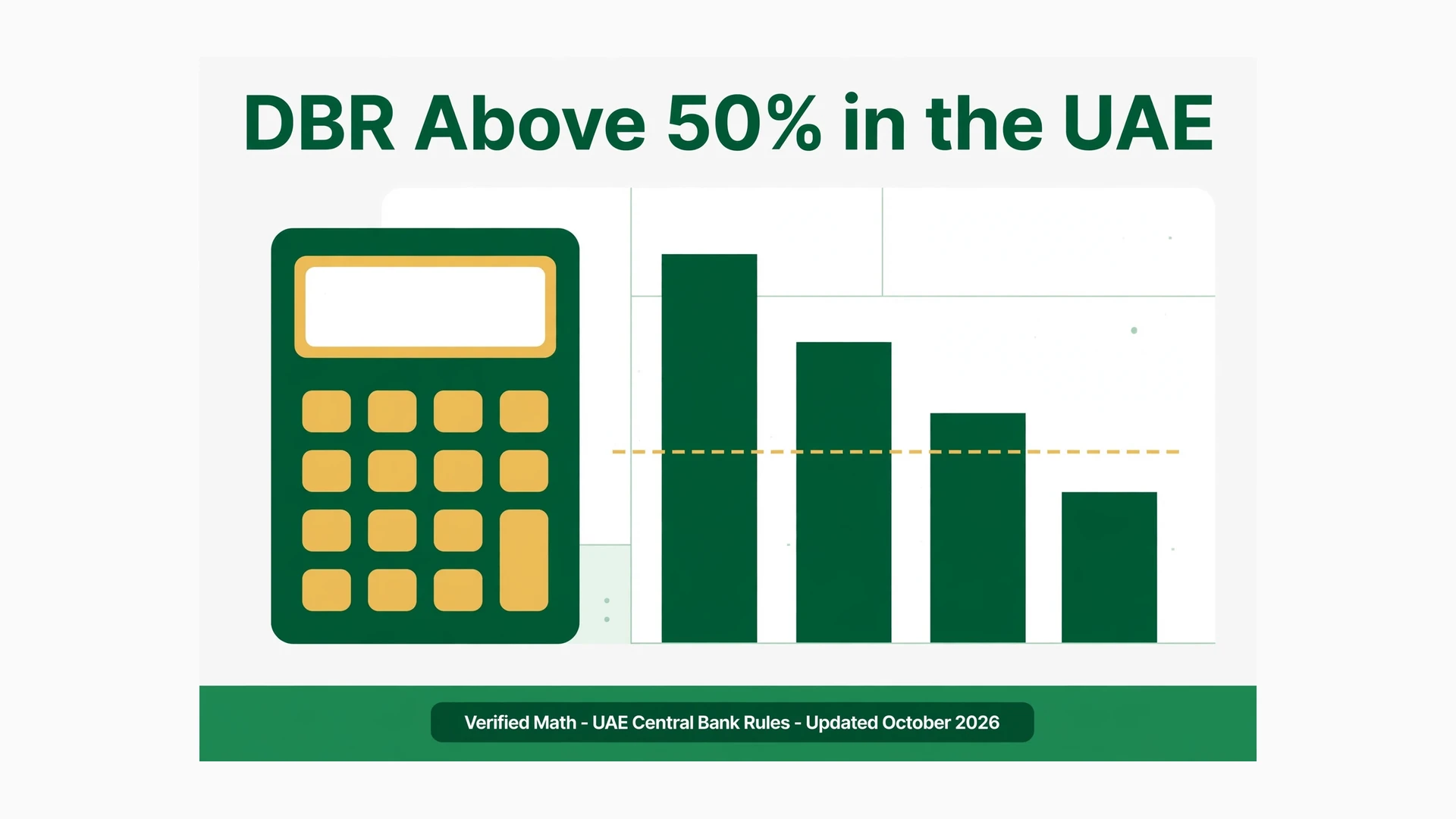
Your debt burden ratio, or DBR, is all of your monthly debt payments divided by your gross monthly income. The Central Bank requires the total, including the new mortgage payment, to stay at or below 50%. Loan instalments count in full. Credit cards count at 5% of the card limit, a bank convention explained below. Rent, school fees and living costs do not count, because they are expenses rather than debts. Our guide to calculating your DBR walks through the ratio on its own, and the DBR calculator runs it directly.
Cap 2: the income multiple
The Central Bank also caps the size of the loan itself: a maximum of seven years of annual income for expatriates and eight years for UAE nationals. On a salary of AED 30,000 a month, that is AED 2,520,000 for an expat and AED 2,880,000 for a national. Broker sites often describe this multiple as an informal sense check. The Central Bank’s own Financial Stability Report states it as a cap on the maximum financing amount, and banks enforce it that way.
Cap 3: the loan-to-value tier
The loan-to-value, or LTV, limit sets the largest share of the property price a bank may finance. It depends on your residency, whether the home is your first, and its value. The tiers sit in the deposit section below. Your maximum property price is your maximum loan divided by your LTV tier, and the difference is the deposit you must hold in cash.
Methodology: every figure in this guide is calculated the way a bank affordability assessment runs. The payment is tested at a stressed rate 2% above a stated contract rate, over a 25-year term, the longest the Central Bank allows. The maximum loan is the lower of the payment-based result and the income multiple. The property figure divides that loan by the first-home LTV for a ready property under AED 5 million. Rates are illustrations, not offers.
The formula banks run
Step 1: Monthly payment room = (Gross monthly income x 50%) minus existing monthly liabilities
Step 2: Payment-based loan = the loan that payment supports at the stressed rate (contract rate + 2%) over your term
Step 3: Maximum loan = the lower of the payment-based loan and (annual income x 7 or x 8)
Step 4: Maximum property = maximum loan divided by your LTV tier; deposit = property minus loan
Two parts of this formula surprise people. First, the payment in Step 1 is tested at the stressed rate in Step 2, not at the rate on the offer letter. Banks do this so that a rate rise after drawdown does not push you over the 50% line. The Central Bank does not publish the 2% figure; it is standard bank practice, and some banks test harder. Second, the income multiple in Step 3 only bites when rates are low or debts are small, which is exactly when buyers expect the largest loans. Example 2 below shows it binding.
Once you have the loan, the monthly payment at the actual contract rate is a separate calculation. Our guide to how EMI is calculated in the UAE covers the payment maths, and the mortgage EMI calculator splits any loan into payment, interest and principal.
The salary ladder: six incomes worked in full
The table assumes an expat resident buying a first ready home, no existing debts, a contract rate of 4.5% tested at a stressed 6.5%, and a 25-year term. Read across to see how the answer is built, not just the answer.
| Monthly salary | Max payment (50%) | Loan from DBR test | Income cap (7x) | Maximum loan | Max property (80% LTV) | Deposit needed |
|---|---|---|---|---|---|---|
| AED 15,000 | AED 7,500 | AED 1,110,770 | AED 1,260,000 | AED 1,110,770 | AED 1,388,463 | AED 277,693 |
| AED 20,000 | AED 10,000 | AED 1,481,027 | AED 1,680,000 | AED 1,481,027 | AED 1,851,284 | AED 370,257 |
| AED 25,000 | AED 12,500 | AED 1,851,284 | AED 2,100,000 | AED 1,851,284 | AED 2,314,105 | AED 462,821 |
| AED 30,000 | AED 15,000 | AED 2,221,540 | AED 2,520,000 | AED 2,221,540 | AED 2,776,926 | AED 555,385 |
| AED 40,000 | AED 20,000 | AED 2,962,054 | AED 3,360,000 | AED 2,962,054 | AED 3,702,567 | AED 740,513 |
| AED 50,000 | AED 25,000 | AED 3,702,567 | AED 4,200,000 | AED 3,702,567 | AED 4,628,209 | AED 925,642 |
Each additional AED 5,000 of monthly salary adds about AED 370,257 of loan at these rates, because the relationship between salary and loan is linear until the income multiple or a debt interrupts it.
Notice that the income cap never binds in this table. At a 6.5% stressed rate the payment test is tighter than seven times annual income at every salary shown. Lower the rate and the picture flips, which is the subject of Example 2.
Worked examples: debts, a low rate, a national buyer
Example 1: AED 30,000 salary with a car loan and a credit card
An expat earns AED 30,000 a month. A car loan takes AED 1,850 a month. One credit card has a limit of AED 60,000 and a balance of zero.
- DBR allowance: 50% of AED 30,000 = AED 15,000
- Liabilities as the bank counts them: car loan AED 1,850, plus 5% of the card limit AED 3,000, total AED 4,850
- Room left for a mortgage payment: AED 15,000 minus AED 4,850 = AED 10,150
- Loan that payment supports at the 6.5% stressed rate over 25 years: AED 1,503,242
- Income cap check: 7 x AED 360,000 = AED 2,520,000, so the DBR test binds
- Maximum property at 80% LTV: AED 1,879,053, with a deposit of AED 375,811
Debt-free, the same salary supports AED 2,221,540. The car loan and the unused card together cost AED 718,298 of loan and AED 897,873 of property budget. If you plan to apply within the year, clearing the car loan and cutting the card limit are worth more than a small pay rise. Our guide on what to do when your DBR is above 50% covers the order to tackle debts in.
Example 2: when the income multiple binds instead
An expat earns AED 20,000 a month with no debts, and finds a mortgage at a 3.0% contract rate, tested at a stressed 5.0%.
- DBR allowance: 50% of AED 20,000 = AED 10,000, all of it free for the mortgage
- Loan that payment supports at the 5.0% stressed rate over 25 years: AED 1,710,600
- Income cap: 7 x AED 240,000 = AED 1,680,000
- Maximum loan: AED 1,680,000, set by the income multiple, not the payment
- Maximum property at 80% LTV: AED 2,100,000, with a deposit of AED 420,000
The cheaper the money, the sooner this cap arrives. At the 6.5% stressed rate in the ladder, the same salary stops at AED 1,481,027 and the cap stays out of reach. Any affordability figure that ignores the income multiple overstates low-rate cases, which is why several popular salary tables online are too generous.
Example 3: a UAE national on the same AED 30,000 salary
A UAE national earns AED 30,000 a month with no debts, at the same 4.5% contract rate tested at 6.5%.
- DBR allowance: 50% of AED 30,000 = AED 15,000, the same cap as an expat
- Loan that payment supports: AED 2,221,540, again the same
- Income cap check: 8 x AED 360,000 = AED 2,880,000, so the DBR test binds
- Maximum property at the 85% first-home LTV: AED 2,613,577, with a deposit of AED 392,037
The national advantage is real but it sits in the deposit and the income multiple, not in the DBR. Put the two buyers side by side on the same AED 2,000,000 home: the expat borrows AED 1,600,000 and needs AED 400,000 in cash, while the national borrows AED 1,700,000 and needs AED 300,000. Both loans fit inside a AED 15,000 payment allowance at the stressed rate, at AED 10,803 and AED 11,479 respectively.
The credit card trap
Banks do not ask what you owe on your cards. They ask what you could owe. The standard treatment is to count 5% of each card’s total limit as a monthly liability inside your DBR, whether the balance is zero or maxed out. It is bank practice rather than a Central Bank figure, but every major lender applies a version of it.
The arithmetic is unforgiving. A AED 100,000 limit counts as AED 5,000 a month, and at a 6.5% stressed rate that slice of payment is worth AED 740,513 of mortgage. A AED 2,000 monthly car instalment uses up AED 296,205 on the same basis. Before you apply, ask each card issuer to reduce limits you do not use, and let at least one statement cycle pass so the lower limit shows on your credit file. Closing a card entirely also works, but keep your oldest card if you can, since a longer credit history helps your AECB score.
The deposit side: LTV tiers
Passing the income tests only sets your loan. The property you can buy also depends on how much of its price the bank may finance, and on the deposit you actually hold. The Central Bank tiers are:
| Property | UAE national | Expat resident | Minimum deposit |
|---|---|---|---|
| First home, AED 5 million or less | 85% | 80% | 15% / 20% |
| First home, above AED 5 million | 75% | 70% | 25% / 30% |
| Second or later property | 65% | 60% | 35% / 40% |
| Off-plan property | 50% | 50% | 50% |
Non-residents sit outside these tiers. Each bank sets its own non-resident terms, and most lend between 50% and 65% of the value. Two practical points follow from the table. First, the deposit in the ladder above is a minimum, not a budget: purchase fees such as the 4% Dubai Land Department transfer fee, agency commission and bank charges sit on top of it, and some banks will finance fees only inside the same LTV cap. Second, a larger deposit than the minimum can rescue a purchase when the income tests fall slightly short, because a smaller loan needs a smaller payment.
Eligibility beyond salary
Salary sets the ceilings. These bank checks decide whether you reach them:
- Minimum salary. The Central Bank sets no minimum salary for a mortgage. Banks set their own, and published minimums at major lenders run from about AED 10,000 to AED 15,000 a month for resident expats, with some products for nationals starting lower. A salary under the floor fails before the DBR test is even run.
- Employment. Most banks want your probation completed and six to twelve months of service, often with the same employer. Self-employed applicants are assessed on business income with a discount, supported by a trade licence and company bank statements.
- Age at the end of the loan. The Central Bank caps the term at 25 years but sets no age limit. Banks set their own, and most require the loan to end by 65 for salaried borrowers and 70 for the self-employed. A 45-year-old salaried borrower may therefore be offered 20 years, not 25, which raises the payment and lowers the loan.
- Credit history. Your AECB report shows every loan, card and missed payment. Banks pull it on every application, and a weak score can cut the loan or end the application regardless of salary.
- What counts as income. Fixed allowances in your contract usually count in full. Bonuses and commissions are averaged and discounted, and rental income is typically counted at 70% to 80% of the rent with tenancy contracts as proof.
- Joint applications. Many banks will combine two salaries, usually spouses, into one household income for the DBR test. The caps then apply to the combined figure.
Which cap binds for you?
| Your situation | The cap that binds | What to do |
|---|---|---|
| No debts, salary of AED 25,000 or more, rates at 4.5% or higher | DBR payment test | Your loan is the ladder figure for your salary. A longer term will not help past 25 years. |
| A rate offer under about 3.5% | Income multiple | Check 7x or 8x your annual income before you celebrate the payment maths. |
| High card limits, even unused | DBR, through the 5% rule | Cut the limits. Every AED 100,000 of limit removed frees about AED 740,513 of loan at a 6.5% stressed rate. |
| A car loan with two or more years to run | DBR | Compare clearing the loan against the extra deposit it would consume. The instalment usually costs more capacity than the cash is worth. |
| Deposit saved is under 20% of the price | LTV tier | The loan may pass while the purchase fails. Price the fees on top of the deposit before you search. |
| Buying a second property or off-plan | LTV tier | The caps fall to 65% or 60%, and to 50% off-plan. Income strength does not soften them. |
| Age plus a 25-year term passes your bank limit | Term and age policy | Model a shorter term. The payment rises, so re-run the DBR test at that term. |
Before you apply: checklist
- Pull your AECB credit report and check every loan and card limit it shows. Dispute errors before a bank sees them.
- List your liabilities the way a bank counts them: every instalment in full, plus 5% of each card limit.
- Reduce unused card limits, or close the cards, at least one statement cycle before applying.
- Get a salary certificate that shows your full package, basic salary plus fixed allowances.
- Prepare six months of bank statements, and be ready to explain any large deposits.
- Confirm your probation is complete and note your length of service with your current employer.
- Run your figures through the affordability calculator, then ask two or three banks for pre-approval rather than one.
- Hold the deposit plus purchase fees in cash, separate from your deposit figure.
Common mistakes
- Sizing the loan at the contract rate. A payment of AED 15,000 supports AED 2,698,655 at 4.5% but AED 2,221,540 at the 6.5% stressed rate. Banks use the second figure.
- Trusting a 65% DBR for nationals. Broker content repeats it, and it is wrong. The Central Bank cap is 50% for everyone; 65% is the second-property LTV tier for nationals, a different rule entirely.
- Forgetting the income multiple. Low-rate cases hit 7x or 8x annual income while the payment maths still looks comfortable.
- Counting card balances instead of limits. The balance is irrelevant to the test. The limit is what counts, at 5% a month.
- Budgeting the deposit and nothing else. Transfer fees, agency commission and bank charges add roughly 6% to 8% of the price in cash on top of the deposit.
- Applying during probation or straight after a job change. Most banks will defer the application until your service record settles, whatever your salary.
Myth vs fact
Myth: UAE nationals can put 65% of their income toward debt.
Fact: The Central Bank caps the debt burden ratio at 50% of gross monthly income for every borrower. Nationals get higher LTV tiers and an 8x income multiple instead. The only DBR above 50% in the rules is 60%, and it applies solely to nationals borrowing under a government housing programme.
Myth: The salary multiplier is a rough bank rule of thumb you can negotiate around.
Fact: The maximum financing amount, seven years of annual income for expats and eight for nationals, is stated in the Central Bank’s own reporting of its borrower-based controls. A bank cannot waive it.
Myth: A credit card you pay off in full every month does not affect a mortgage application.
Fact: Banks count 5% of the limit as a monthly liability regardless of the balance, because the limit is debt you could take on tomorrow.
Myth: If the monthly payment looks affordable on your salary, the bank will approve that loan.
Fact: The bank tests the payment at a stressed rate about 2% higher, applies the income multiple, and checks the deposit against your LTV tier. A loan has to pass all of it.
Frequently asked questions
How much mortgage can I get on a salary of AED 30,000?
With no existing debts, a contract rate of 4.5% and a 25-year term, the stressed payment test supports AED 2,221,540, and the income caps (AED 2,520,000 for an expat, AED 2,880,000 for a national) do not bind. With a car loan of AED 1,850 and a credit card limit of AED 60,000, the same salary supports AED 1,503,242. Your own figure sits between those poles and depends on your debts, so run it in the mortgage affordability calculator.
What salary do I need for a AED 2 million mortgage?
At a 4.5% contract rate tested at 6.5% over 25 years, a AED 2,000,000 loan needs a stressed payment of AED 13,504, which means a gross salary of about AED 27,008 a month with no other debts. The income multiple sets a lower floor of AED 23,810, so the payment test is the one to satisfy. Existing debts push the required salary up quickly.
What salary do I need to buy a AED 1 million home?
At 80% LTV the loan is AED 800,000, which needs a stressed payment of AED 5,402 and therefore a salary of about AED 10,800 a month with no other debts. In practice the binding constraint at this level is often the bank’s own minimum salary, typically AED 10,000 to AED 15,000, plus the AED 200,000 deposit and fees in cash.
Is the 50% DBR the same for UAE nationals?
Yes. The Central Bank ceiling is 50% of gross monthly income for nationals, expats and, where banks lend to them, non-residents. The single exception is a national borrowing under a government housing programme, where the ceiling is 60%. Websites showing a 60% or 65% general tier for nationals are misreading the rules.
How do credit cards affect how much I can borrow?
Banks count 5% of each card’s limit as a monthly liability inside your DBR, whatever the balance. A AED 100,000 limit therefore consumes AED 5,000 of monthly room, worth about AED 740,513 of mortgage at a 6.5% stressed rate. Reducing limits before you apply is one of the fastest ways to raise your maximum loan.
Can a longer term get me a bigger mortgage?
Only up to a point. The Central Bank caps the term at 25 years, and your bank’s age limit at the end of the loan can shorten it further, commonly to a finish by age 65 if you are salaried. Within those limits a longer term lowers the payment and raises the loan, but the income multiple still caps the total.
Is there a minimum salary for a mortgage in the UAE?
Not from the Central Bank. Each bank sets its own minimum, and published floors at major lenders run from about AED 10,000 to AED 15,000 a month for resident expats. Some banks accept less for UAE nationals or for salary-transfer customers, and self-employed applicants are usually asked for more.
My DBR is already above 50%. Can I still get a mortgage?
Not until it comes down. The bank must fit the new mortgage inside the same 50%, so the routes are paying down instalment debt, cutting card limits, adding a co-borrower income, or choosing a cheaper property. Our guide on bringing a DBR above 50% back down works through the options in order of impact.
Put your own numbers through the caps
The ladder gives you the shape. Your debts, your card limits and your residency decide your figure. Run them now, before you book a viewing.
Calculate My Maximum MortgageSources and Methodology
- Central Bank of the UAE, Financial Stability Report 2025: the loan-to-value table (first home 85% nationals and 80% expatriates at or under AED 5 million, 75% and 70% above it, subsequent property 65% and 60%, off-plan 50%) and the borrower-based controls (50% debt burden ratio, maximum financing of eight years of annual income for nationals and seven for expatriates, 25-year maximum tenor).
- Central Bank of the UAE, Regulations Regarding Mortgage Loans (Circular No. 31 of 2013, as amended by Board of Directors Resolution No. 31/2 of 2020): the underlying mortgage lending rules, including the 2020 amendment that raised first-home loan-to-value limits by five percentage points.
How we verify: the caps quoted here are taken from the Central Bank sources above, and every worked example was recomputed by hand from the formula in this guide before publication. Where the Central Bank sets no figure, the guide says so: the 2% stress buffer and the 5%-of-limit card treatment are standard bank practice, minimum salaries and age limits are set by each bank, and the rate used in examples is an illustration, not a quote. Figures are estimates for planning; a bank’s own assessment of your file is the number that counts.
Last updated: October 2026.